Positive Behavior Support (PBS): A Parent's Guide
Quick answer
What PBS actually is, how it differs from ABA, what PBIS means at school, and how to use it at home.
Get our free fall activities guide
10 autism-friendly fall activities, each with who it suits and how to make it work, plus an outing planner. Free PDF, downloaded instantly.
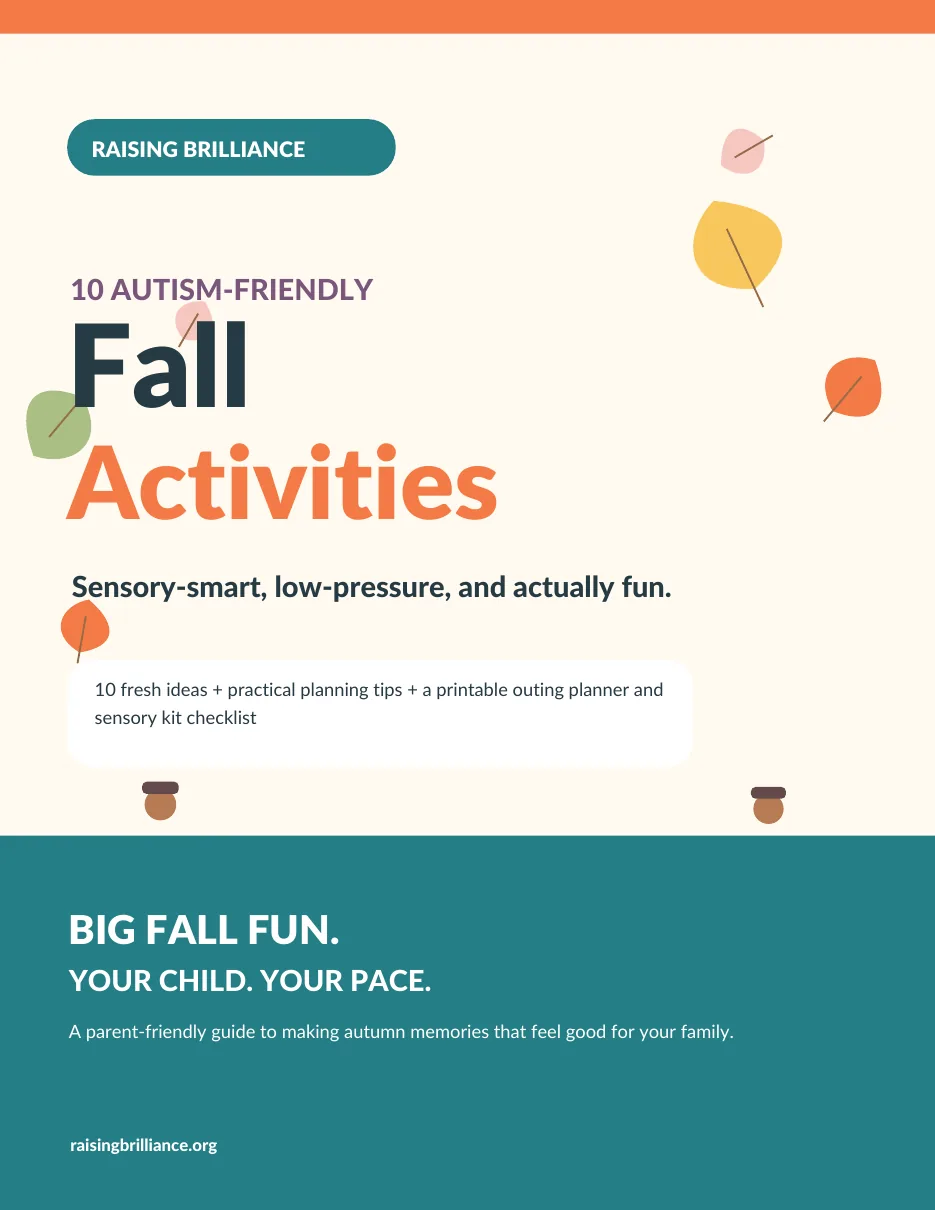
10 Autism-Friendly Fall Activities — free PDF, downloaded instantly.
No spam. Unsubscribe any time.
Quick answer: Positive Behavior Support (PBS) is a person-centered way of helping someone whose behavior is getting in the way of their life. Instead of punishing or suppressing behavior, PBS starts by asking why the behavior is happening — what it communicates, what need it meets — then changes the environment, teaches skills that meet the same need more safely, and measures success by quality of life, not just compliance. At school you will usually meet it as PBIS (Positive Behavioral Interventions and Supports), a three-tier framework used district-wide. PBS grew out of applied behavior analysis (ABA) but is broader, more values-driven, and generally better aligned with a neurodiversity-affirming approach.
What positive behavior support means
Positive Behavior Support emerged in the late 1980s and 1990s, partly as a response to the aversive, punishment-heavy behavior interventions that were then common for disabled people. Researchers and advocates argued for a different starting point: all behavior — including behavior that looks like "a problem" — serves a purpose for the person doing it. A child who bolts from the classroom may be escaping sensory overload. A child who hits may have no other reliable way to say "stop." A child who melts down at transitions may be losing the only predictability holding their day together.
PBS takes that seriously. Rather than asking "how do we stop this behavior," it asks "what is this behavior doing for this child — and how do we make the behavior unnecessary?" That usually means changing the situation around the child at least as much as asking the child to change.
The Association for Positive Behavior Support describes PBS as blending behavioral science with person-centered values: the goal is a better life — relationships, participation, autonomy, learning — with behavior change as a means to that end, not the end itself.
The core ideas behind PBS
- Behavior is communication. Especially for children with limited spoken language, behavior often carries the message. PBS treats decoding that message as step one.
- Prevention beats reaction. Most PBS work happens before behavior occurs: adjusting environments, routines, sensory load, demands, and warning of transitions so the hard moments come up less often.
- Teach a better tool, don't just remove the old one. If a behavior meets a real need, suppressing it without offering an alternative fails — or the need resurfaces in another form. PBS explicitly teaches replacement skills: asking for a break, using an AAC device, signaling "too loud."
- Quality of life is the outcome that counts. A plan that produces a quieter child who is also more anxious and less engaged has failed by PBS standards.
- No aversives. PBS rejects pain, humiliation, and intimidation as behavior tools, full stop.
- Data guides decisions. Progress gets tracked, and plans change when the data says they are not working.
What PBS looks like in practice
Formal PBS usually starts with a functional behavior assessment (FBA) — a structured look at when a behavior happens, what tends to come right before it, and what follows it. The FBA produces a working hypothesis ("Marco drops to the floor during writing tasks because fine-motor work is exhausting and dropping reliably gets him out of it").
From there, the team writes a behavior support plan (at school, often called a behavior intervention plan or BIP) with three kinds of strategies:
- Prevention — shorten the writing task, offer a pencil grip or typing, schedule it after movement time.
- Teaching — teach Marco to ask for a break with a card or device, and honor it every time so the new skill actually works better than the old behavior.
- Response — when the behavior still happens, respond calmly in a planned way that keeps everyone safe without accidentally making the behavior the most effective tool in the room.
Done well, the process includes the family — and wherever possible the child — as genuine partners. If a plan is being written about your child without you, that is not PBS done well.
PBS vs ABA: what is the difference?
Parents hear both terms constantly, often from the same providers, and the honest answer is that they are related but not the same thing.
| ABA | PBS | |
|---|---|---|
| Origin | Behavioral science applied to teaching and behavior change | Grew out of ABA in the late 1980s, merging it with person-centered and inclusion values |
| Primary focus | Teaching skills and changing specific behaviors, often through structured therapy hours | Redesigning environments and routines so life works better; behavior change follows |
| Where it happens | Often clinic- or home-based therapy sessions | Wherever the person lives their life — home, school, community |
| Success measure | Progress on targeted skills and behavior goals | Quality of life: participation, relationships, autonomy — plus behavior change |
| Typical intensity | Frequently delivered as many weekly therapy hours | A plan everyone around the child follows, rather than a dose of therapy |
In practice the line blurs: many modern ABA providers describe their approach as PBS-informed, and PBS plans use behavioral tools that come straight from ABA. If you are evaluating providers, the label matters less than the practice. Ask: Do you start with why the behavior happens? Do you change the environment, or only the child? How do you treat stimming? What does success look like? A provider fluent in PBS will answer in terms of your child's life, not just their behavior chart. For local options, see our ABA therapy listings by city and bring these questions to every interview.
PBIS: positive behavior support at school
At school, PBS shows up as PBIS — Positive Behavioral Interventions and Supports — a schoolwide framework used in tens of thousands of US schools and supported federally through the Center on PBIS. PBIS organizes support in three tiers:
- Tier 1 — everyone. Schoolwide expectations taught explicitly, predictable routines, and recognition systems for all students.
- Tier 2 — some students. Targeted extra support for kids who need more: check-in/check-out systems, social skills groups, mentoring.
- Tier 3 — individual. Intensive, individualized support — this is where the FBA and behavior intervention plan live, usually alongside an IEP or 504 plan.
For parents of autistic kids, the practical takeaways: a school using PBIS should be able to show you what each tier looks like; you can request an FBA in writing whenever behavior is interfering with your child's learning; and a behavior plan built on PBIS principles should emphasize prevention and skill-teaching, not consequences. If your child's plan is mostly a list of what happens after behavior, push for better — our IEP guide covers how.
Using PBS at home
You do not need a formal program to use PBS thinking at home:
- Play detective before you play referee. For one week, jot down when the hard moments happen — time, place, what came before, what followed. Patterns usually appear fast.
- Change the setup first. If every meltdown happens during the after-school hour, the answer may be a snack, a dark quiet room, and zero demands for thirty minutes — not a behavior chart. Our meltdown guide goes deeper on this.
- Give the need a better tool. Whatever the behavior achieves — escape, attention, sensory input, predictability — build an easier, safer way to get the same thing, and honor it reliably.
- Praise the direction, not perfection. Notice and name what is going well, specifically and often.
- Keep your own data, loosely. Even a note on your phone tells you in a month whether things are actually improving or you are just having a good week.
Is PBS a good fit for autistic kids?
Broadly, PBS is one of the more neurodiversity-compatible behavior frameworks: it locates much of the problem in the environment, bans aversives, and defines success as a better life. Many autistic adults who are critical of intensive behavior therapy are considerably warmer toward PBS-style support.
Two honest caveats. First, anything built on behavior science can be practiced badly — a "PBS plan" that targets harmless autistic traits like stimming or avoiding eye contact is not supporting your child; it is training masking. The goal should always be safety, communication, and access to life, never looking less autistic. Second, labels are marketing as well as method: judge any provider or school by what they actually do. If a plan reduces distress, builds real skills, and makes your child's world bigger, it is working. If it produces compliance and anxiety, it is not — whatever it is called.
How to find PBS support
- At school: ask whether the school uses PBIS, and request an FBA in writing if behavior is affecting learning. The special education team is the entry point — see our IEP guide.
- Through providers: behavior analysts (BCBAs), psychologists, and some SLPs and OTs practice PBS-informed support. Interview with the questions above; our city listings are a starting point.
- Through your state: many states run PBS networks or training programs for families through university centers and developmental disability agencies — search your state plus "positive behavior support network."
- Learn more: the Association for Positive Behavior Support and the Center on PBIS both publish free family-facing resources.
Related guides
See our guides to autism meltdowns, meltdowns vs shutdowns, what stimming is, the IEP for autism, and autism rights and advocacy.
Raising Brilliance is a free weekly newsletter and resource for families raising autistic children — practical, calm, and respectful of autistic people. Join over 1,000 families.
Related guides
AAC Devices for Autism: A Parent's Guide
Augmentative and alternative communication, how it works, how to fund it, and why it does not delay speech.
Autism Therapy Options: A Guide for Families
The main therapies, what each one actually does, how to choose, and how they are paid for.
Is ABA Therapy Harmful? A Balanced Parent's Guide
The honest version: some ABA causes real harm, some helps, and the difference is in the specific program.
Parent Training Programs for Autism: A Guide
What parent-mediated programs are, what they do, and how to find one — without the pressure.
Supporting Non-Speaking Autistic Children
Presuming competence, understanding AAC, and making sure every child has a way to communicate.
Find this near you
Browse local autism resources by topic and find providers and programs in your city.
Get our free fall activities guide
10 autism-friendly fall activities, each with who it suits and how to make it work, plus an outing planner. Free PDF, downloaded instantly.
No spam. Unsubscribe any time. Join 2,000+ parents on the list.