Autism Testing: How It Works and How to Find It Near You
Quick answer
What the tests actually are, who administers them, what an evaluation day looks like, and how to find testing in your city.
Get our free fall activities guide
10 autism-friendly fall activities, each with who it suits and how to make it work, plus an outing planner. Free PDF, downloaded instantly.
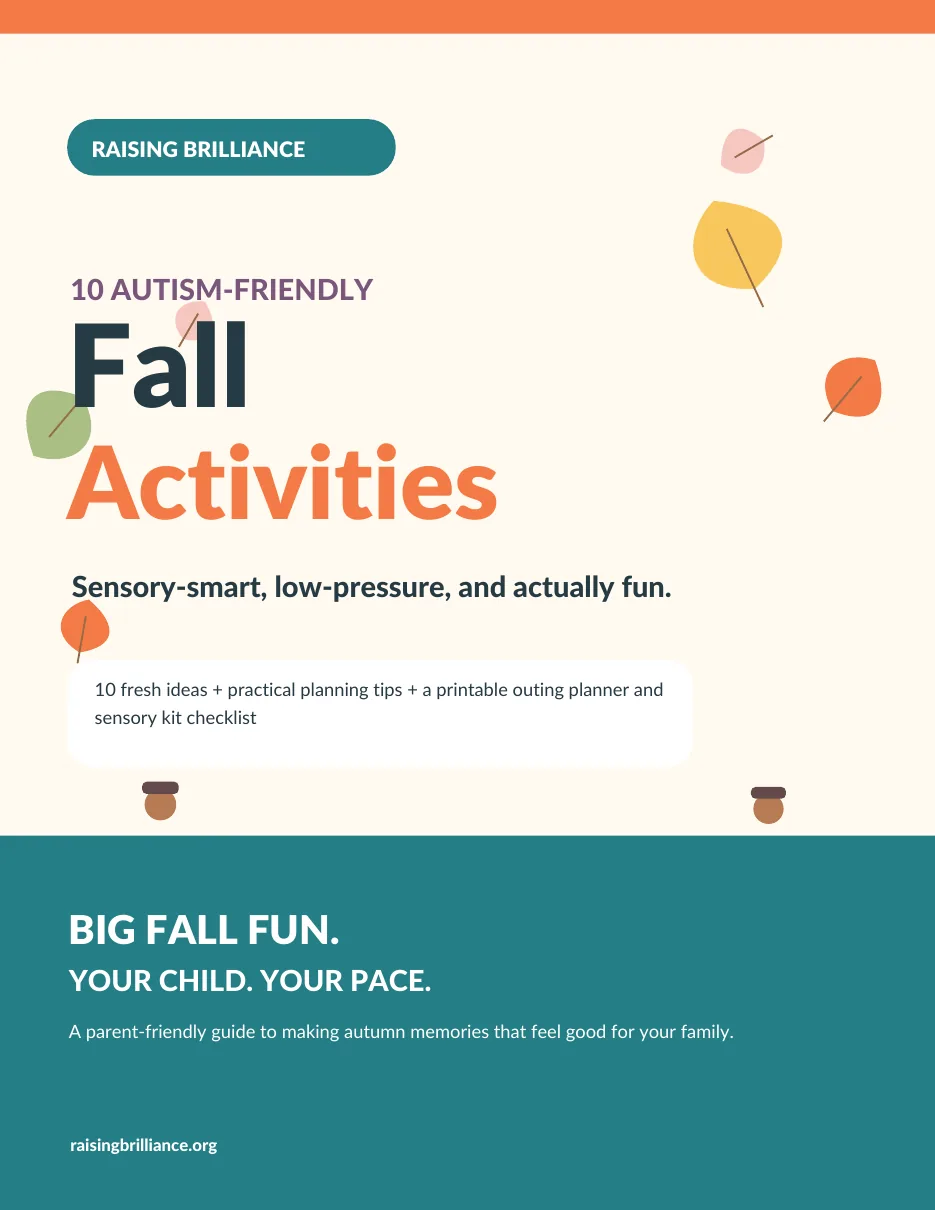
10 Autism-Friendly Fall Activities — free PDF, downloaded instantly.
No spam. Unsubscribe any time.
If you have searched "autism testing near me," you probably want two things: to understand what the testing actually involves, and to find someone near you who can do it. This guide covers both. It focuses on the testing itself — the instruments, who administers them, what an evaluation day looks like, what it costs, and why the wait is so long. For a step-by-step walkthrough of the referral pathways and what to do while you wait, see our companion guide, how to get an autism evaluation.
One thing to know up front: there is no blood test, brain scan, or single lab result that diagnoses autism. Autism testing is a clinical and behavioral evaluation. A trained professional observes your child, interviews you, uses standardized assessment tools, and compares what they find against established diagnostic criteria. Understanding that changes what you should expect — and helps you spot providers who overpromise.
What autism testing actually is
Autism is diagnosed by evaluating behavior and development, not biology. Clinicians in the US diagnose against the criteria in the DSM-5-TR (the Diagnostic and Statistical Manual of Mental Disorders, Fifth Edition, Text Revision), which describes autism spectrum disorder in terms of two core areas: persistent differences in social communication and interaction, and restricted or repetitive patterns of behavior, interests, or activities — present from early development and affecting everyday functioning.
Because there is no biological marker, "testing" means gathering evidence from several angles: what you report about your child's history and daily life, how your child interacts and plays during structured tasks, and how they score on standardized instruments. A good evaluator weighs all of it together. The instruments support clinical judgment; they do not replace it.
It also matters to separate screening from diagnosis. A screen is a short questionnaire that flags whether a fuller look is warranted. It cannot diagnose autism. The most common screen is the M-CHAT-R/F (Modified Checklist for Autism in Toddlers, Revised, with Follow-Up) — 20 yes/no questions parents answer, used for children roughly 16 to 30 months old, usually at the 18-month and 24-month pediatric checkups. A concerning M-CHAT-R/F result is a reason to seek a full evaluation, not a diagnosis in itself.
The tests and instruments
A comprehensive autism evaluation usually draws on several standardized tools. You do not need to become an expert in these, but knowing the names helps you understand what a thorough evaluation includes:
- ADOS-2 (Autism Diagnostic Observation Schedule, Second Edition) — a standardized, play- and activity-based observation the clinician conducts directly with your child. It is widely considered a gold-standard observational tool, with modules for different ages and language levels, and its scores map onto DSM-5 criteria.
- ADI-R (Autism Diagnostic Interview-Revised) — a structured, in-depth interview with parents or caregivers covering early development, communication, social interaction, and repetitive behaviors. The ADOS-2 and ADI-R are often used together as complementary sources.
- Cognitive and developmental testing — measures of thinking, problem-solving, and (for young children) developmental level, used to understand your child's overall profile of strengths and challenges.
- Language and speech assessment — often part of the picture, sometimes done by a speech-language pathologist.
- Adaptive behavior assessment — commonly the Vineland Adaptive Behavior Scales, which measure how a child actually functions day to day: self-care, communication, social and motor skills.
- Developmental and medical history — a detailed review of pregnancy, birth, milestones, family history, medical records, and prior evaluations or school reports.
No single one of these produces a diagnosis on its own. The clinician integrates them, alongside direct observation, and reaches a judgment against the DSM-5-TR criteria.
Who does the testing
A formal medical autism diagnosis comes from a qualified clinician trained in autism assessment. Depending on where you live and your child's needs, that may be:
- Developmental-behavioral pediatricians — medical doctors with subspecialty training in child development, often regarded as a gold standard for diagnosing autism in children. You can find developmental pediatricians near you to compare local options.
- Child psychologists and pediatric neuropsychologists — usually PhD- or PsyD-level clinicians with specific training in autism testing.
- Child and adolescent psychiatrists — physicians who can diagnose and also manage co-occurring conditions.
- Pediatric neurologists — physicians who evaluate neurological development and rule out related conditions.
- Multidisciplinary teams — at many autism centers and academic hospitals, several of these professionals evaluate together and combine findings.
Your general pediatrician plays an important role but usually does not make the diagnosis themselves. Most pediatricians screen, watch for concerns, and refer to a specialist — though this is shifting, and some primary-care settings now use FDA-authorized diagnostic aids to help identify autism earlier. A speech-language pathologist or occupational therapist cannot diagnose autism alone, but their evaluations often feed into the process and can trigger a referral.
School evaluation vs. medical diagnosis
This distinction confuses many families, and it is important. A school evaluation and a medical diagnosis are not the same thing, and one does not automatically produce the other.
- A medical (clinical) diagnosis is made by a healthcare provider using the DSM-5-TR. It is what insurance, medical services, and many therapy providers require.
- A school evaluation determines whether a child qualifies for special education under the educational category of autism as defined by IDEA (the Individuals with Disabilities Education Act). It unlocks an IEP and school-based services — but it is an educational eligibility decision, not a medical diagnosis.
A child can have one without the other. Many families pursue both, because they serve different purposes: the medical diagnosis for clinical care and insurance, the school evaluation for educational support. School evaluations are free and can move faster, which is why they are worth requesting in parallel. We walk through how to request each pathway in how to get an autism evaluation.
Testing by age
Toddlers and young children (birth to 3). Every state runs a free, federally funded Early Intervention program for children under 3 with developmental concerns. You can self-refer — no diagnosis or doctor's referral needed. Early Intervention does not usually issue a formal autism diagnosis, but it identifies delays, starts services quickly, and runs in parallel while you pursue diagnostic testing. Signs often become noticeable in this window; see early signs of autism for what to watch for.
Preschool and school-age (3 and up). Once a child turns 3, the local public school district must evaluate for educational eligibility for free on request, even for homeschooled and private-school children. Alongside this, families pursue a medical evaluation through a specialist.
Teens. Autism is sometimes identified later, especially in kids who mask their differences or whose needs were attributed to something else. Evaluation is similar but weighs self-report, social and academic history, and co-occurring anxiety or attention differences more heavily.
Adults. Adult autism testing is real and increasingly sought, but it is genuinely harder to access. Far fewer clinicians specialize in adult diagnosis, there are no childhood-observation opportunities, and history has to be reconstructed. Insurance covers adult diagnostic evaluations less consistently than children's, even where mandates exist. Adults often start with a psychologist or psychiatrist who has experience with autism in adulthood; university clinics and telehealth practices are frequently the most realistic options.
What an evaluation day looks like
A full evaluation is rarely a single short visit. It usually spans two to four appointments (sometimes more), which may include:
- A caregiver interview about developmental history and current concerns — bring notes, records, and any prior reports.
- Direct observation and structured activities with your child (this is where a tool like the ADOS-2 is used) — often looking like guided play rather than a test.
- Cognitive, language, and adaptive testing, sometimes across more than one session.
- A feedback session where the clinician explains findings, whether criteria were met, and next steps, followed by a written report.
From the first appointment to the written report often takes several weeks. Being on time, bringing documentation, and sharing short videos of your child in everyday settings all help the evaluator see a fuller picture than one office visit can show.
Cost and insurance
What you pay depends heavily on the pathway:
- Early Intervention (under 3) and school district evaluations (3 and up): free.
- Medical evaluation through insurance: all 50 states and DC have autism insurance mandates that require coverage for diagnostic evaluation, so many families pay only a copay or deductible amount. Coverage details still vary by plan and state, so confirm specifics before booking.
- Self-pay / out-of-network medical evaluation: reporting in 2026 puts a full private evaluation without insurance roughly in the $1,200 to $5,000 range, with many private evaluations around $1,500 to $3,000. University and telehealth evaluations tend to run lower, often in the $600 to $1,500 range. Adult evaluations commonly fall around $2,000 to $5,000 without insurance. Treat these as general ranges, not quotes — actual prices vary by provider, scope, and region.
For lower-income families, Medicaid matters a great deal. Under the EPSDT benefit (Early and Periodic Screening, Diagnostic, and Treatment), state Medicaid programs must cover medically necessary diagnostic and treatment services for enrolled children under 21. Coverage for adults depends more on individual state plans and waivers.
Ways to lower cost: ask your insurer specifically about "neurodevelopmental evaluation" or "comprehensive developmental assessment"; ask whether the evaluator is in-network; and look at university training clinics, which supervise graduate clinicians and often charge on a sliding scale.
Waitlists — and how to beat them
For most families, the hardest part of autism testing is not the cost — it is the wait. Demand has far outpaced the supply of qualified evaluators. Autism-specific diagnostic waitlists commonly run 6 to 12 months, and developmental-pediatrician evaluations are frequently booked 9 months to 2 years out. In one survey of US autism centers, most reported waits longer than four months and a meaningful share reported over a year. On average, families wait years from first concern to a completed assessment.
You cannot fix the shortage, but you can shorten your own wait:
- Get on several waitlists at once, then cancel the rest when one opens.
- Ask to be on each provider's cancellation list for earlier openings.
- Run the free pathways in parallel. Start Early Intervention (under 3) or request a school evaluation (3+) now — services can begin before a medical diagnosis is finished.
- Look beyond the big academic centers. Solo psychologists, regional clinics, and university training clinics sometimes have shorter waits.
- Ask about telehealth evaluations. Research finds telehealth autism assessments agree with in-person diagnoses a large majority of the time (studies report roughly 80–88% agreement) when done by an experienced, licensed clinician. Telehealth practices often have shorter waitlists — a reasonable option for many families, though in-person may be better for complex or ambiguous cases.
Find autism testing near you
Where you look depends on your child's age and pathway, but the fastest starting point is a local provider list. We maintain city-by-city guides to autism diagnosis and testing across the country:
- Find autism testing and diagnosis in your city — local evaluators, autism centers, and diagnostic clinics, organized by city.
- Find developmental pediatricians near you — for the specialists most often involved in diagnosing children.
From there, call to ask three questions: do you evaluate my child's age, do you take my insurance, and what is your current wait? Put your name on more than one list. And while you wait, our how to get an autism evaluation guide covers exactly what to do next.
Frequently asked questions
How do I get my child tested for autism? Start with your pediatrician, who can screen and refer, and — depending on age — contact your state's Early Intervention program (under 3) or request a school evaluation in writing (3 and up). For a medical diagnosis, get on the waitlist of a developmental pediatrician, child psychologist, or autism center. Our evaluation guide walks through each pathway step by step.
How much does autism testing cost? Early Intervention and school evaluations are free. With insurance, a medical evaluation is often just a copay, since all 50 states mandate diagnostic coverage. Self-pay evaluations generally run from around $1,200 to $5,000, with university and telehealth clinics usually lower. Medicaid's EPSDT benefit covers evaluations for eligible children under 21.
Can a pediatrician diagnose autism? Usually a general pediatrician screens for autism and refers to a specialist rather than diagnosing it. The formal diagnosis typically comes from a developmental pediatrician, child psychologist or neuropsychologist, child psychiatrist, or pediatric neurologist — though some primary-care settings are beginning to use FDA-authorized tools to diagnose earlier.
Can adults get tested for autism? Yes. Adult testing is available but harder to find, since fewer clinicians specialize in it and insurance coverage is less consistent. Adults often begin with a psychologist or psychiatrist experienced in adult autism; university clinics and telehealth practices are frequently the most accessible options.
How long is the wait for autism testing? Waitlists commonly run 6 to 12 months, and developmental-pediatrician evaluations can be booked 9 months to 2 years out. Getting on multiple lists, asking about cancellations, and using telehealth or university clinics are the main ways to shorten it. Running Early Intervention or a school evaluation in parallel means help can start sooner.
Is a school evaluation the same as a diagnosis? No. A school evaluation decides whether a child qualifies for special education under IDEA — an educational eligibility decision that unlocks an IEP. A medical diagnosis is made by a clinician using DSM-5-TR criteria and is what insurance and medical services require. Many families pursue both.
What tests are used to diagnose autism? There is no blood test. Clinicians use tools such as the ADOS-2 (a structured observation), the ADI-R (a caregiver interview), cognitive and language testing, and adaptive measures like the Vineland — all weighed together against DSM-5-TR criteria. The M-CHAT-R/F is a screening questionnaire for toddlers, not a diagnostic test.
Is telehealth autism testing accurate? For many children it can be. Studies find telehealth evaluations agree with in-person diagnoses a large majority of the time when conducted by experienced, licensed clinicians. In-person assessment may still be preferable for complex or borderline cases.
Related guides
- How to get an autism evaluation
- Early signs of autism
- The first 100 days after an autism diagnosis
- Find autism testing in your city
- Find developmental pediatricians near you
This guide was written by the Raising Brilliance editorial team. We do not diagnose, and we do not replace your child's care team. We provide information families can use to make better decisions and find better support.
Join over 1,000 families reading Raising Brilliance for practical autism resources every week. Subscribe to the free newsletter.
Have a question or want to suggest a topic? Tell us.
Related guides
Autism in Adults: Signs, Diagnosis, and What Comes Next
For adults who suspect they may be autistic — and the families who recognize themselves along the way.
Early Signs of Autism: A Parent's Guide by Age
What to actually look for at each stage — what is and isn't a reliable signal, and what to do if you recognize your child.
How to Get an Autism Evaluation: A Parent's Guide
Three pathways, real costs, real wait times, and what to do while you wait.
The First 100 Days After an Autism Diagnosis
A calm, practical guide for families — what to do, what to skip, and how to find your footing.
Find this near you
Browse local autism resources by topic and find providers and programs in your city.
Get our free fall activities guide
10 autism-friendly fall activities, each with who it suits and how to make it work, plus an outing planner. Free PDF, downloaded instantly.
No spam. Unsubscribe any time. Join 2,000+ parents on the list.