IEP Goals for Autism: Examples and How to Write Good Ones
Quick answer
What makes an IEP goal strong, how autism goals differ, and concrete, measurable sample goals you can bring to the table.
Get our free fall activities guide
10 autism-friendly fall activities, each with who it suits and how to make it work, plus an outing planner. Free PDF, downloaded instantly.
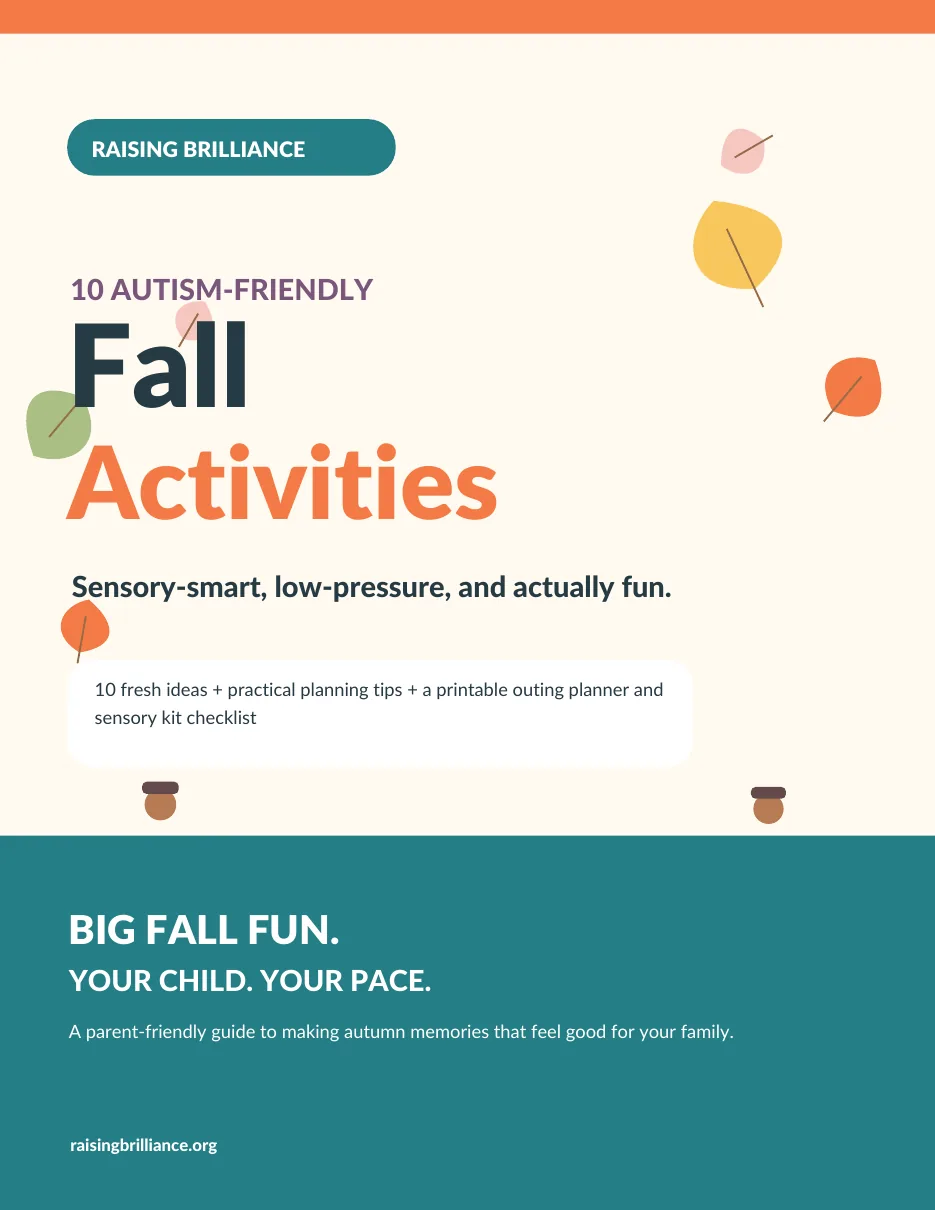
10 Autism-Friendly Fall Activities — free PDF, downloaded instantly.
No spam. Unsubscribe any time.
What makes a good IEP goal
Goals are the engine of an IEP. Everything else — services, minutes, placement — exists to move your child toward the goals. A vague goal produces vague services and unmeasurable progress. A strong goal is specific, measurable, and honest about where your child is starting from.
The widely used shorthand is SMART: Specific, Measurable, Achievable, Relevant, Time-bound. In practice, a well-written IEP goal has five parts:
- A baseline (present level). Where is your child right now? "Given a visual schedule, Sam currently transitions between activities with adult prompting 2 out of 5 times." You cannot measure growth without a starting point, and IDEA requires present levels of performance.
- A specific, observable skill. Not "improve communication" but "request a break using his AAC device."
- The condition. What support or setup is assumed? "Given a picture prompt," "during structured play," "with one verbal reminder."
- A measurable criterion. A number someone can actually score: "in 4 out of 5 opportunities across 3 consecutive sessions."
- A timeframe. Usually "by the next annual review" or a specific date.
A weak goal reads: "Jordan will improve social skills." A strong version reads: "By the annual review, given a structured small-group activity, Jordan will initiate a comment or question to a peer at least 3 times per 20-minute session, in 4 of 5 sessions, as measured by teacher data." The second one tells you exactly what will be taught, what counts as success, and how you will know.
How autism goals differ
Autism goals aren't a different legal category — they follow the same SMART rules — but a few things deserve extra care.
- Skip the "look less autistic" goals. Older IEPs are full of goals about forcing eye contact, eliminating stimming, or "appropriate" behavior. These target the child's neurology rather than a real skill, and they can do harm. Good goals build communication, self-advocacy, and regulation — not masking. Our guide to autism rights and advocacy covers why this framing matters.
- Honor the communication the child already uses. For a non-speaking or minimally speaking child, goals should build around AAC, not treat speech as the only valid outcome.
- Regulation before compliance. A dysregulated child cannot learn. Self-regulation and sensory goals often unlock everything else, so they belong near the top of the list.
- Presume competence. Goals should stretch toward real academic and functional growth, not park a child in low expectations because they are autistic.
Communication, language & AAC goals
Communication is often the highest-leverage area. Sample measurable goals:
- Given access to his AAC device across school settings, [Student] will independently request a preferred item or activity using 2+ symbols in 8 of 10 opportunities across 3 consecutive data days.
- During structured activities, [Student] will spontaneously comment on an object or event (verbally or via AAC) at least 4 times per 30-minute period, in 4 of 5 sessions.
- Given a "break" symbol and a model, [Student] will request a break instead of leaving the area, in 4 of 5 observed opportunities.
Note that these assume AAC is available everywhere the child is — a goal that only works in the speech room is a broken goal. See our guides on AAC devices for autism and supporting non-speaking autistic children.
Social & connection goals
Frame these around authentic participation, not performance:
- During a structured peer activity, [Student] will take a turn and respond to a peer's turn in 4 of 5 opportunities, with no more than one adult prompt.
- [Student] will join a preferred small-group activity and remain engaged for 10 minutes in 4 of 5 opportunities.
- Given a choice of two conflict-resolution strategies (ask for help, take a break), [Student] will select and use one during a peer disagreement in 3 of 4 observed situations.
Avoid goals that police tone, eye contact, or "appropriate" facial expressions.
Behavior & self-regulation goals
The best behavior goals teach a replacement skill, not just "reduce" a behavior:
- When frustrated, [Student] will use a taught calming strategy (deep breaths, break card, sensory tool) before escalating, in 4 of 5 observed instances.
- Given a 5-point scale, [Student] will identify their current level of upset in 4 of 5 check-ins.
- [Student] will transition between activities with a visual timer and one verbal cue in 8 of 10 transitions across 3 weeks.
If behavior is interfering with learning, ask about a functional behavior assessment and a positive behavior support plan rather than a bare "compliance" goal.
Executive function goals
- Using a visual checklist, [Student] will independently begin a multi-step task within 2 minutes of the direction in 8 of 10 opportunities.
- [Student] will use a planner or app to record and locate assignments in 4 of 5 school days across one grading period.
- Given a task broken into steps, [Student] will complete all steps and check them off with no more than one prompt in 4 of 5 tasks.
Adaptive & daily living goals
- [Student] will independently complete the arrival routine (unpack, put away materials, start warm-up) in 4 of 5 days.
- [Student] will manage the restroom routine independently, including handwashing, in 9 of 10 opportunities.
- During lunch, [Student] will open 3 of 4 food packages using taught strategies or request help appropriately in 4 of 5 days.
Academic goals
Tie academics to grade-level standards where possible, adjusted to the child's baseline:
- Given a 2nd-grade passage, [Student] will answer 4 of 5 literal comprehension questions correctly across 3 consecutive assessments.
- [Student] will solve two-digit addition problems with regrouping at 80% accuracy across 3 probes.
- [Student] will write a 3-sentence response with a topic sentence and two details on a familiar prompt in 4 of 5 writing samples.
Motor & sensory goals
- [Student] will use a pencil grasp that supports legible writing for a 4-sentence task in 4 of 5 samples.
- [Student] will navigate playground equipment safely with distant supervision in 4 of 5 recess periods.
- Given a sensory plan, [Student] will use a regulating tool or scheduled sensory break and return to task within 5 minutes in 8 of 10 opportunities.
Sensory supports frequently live in the accommodations section rather than as goals — but if a child is learning to identify and meet a sensory need, that is a legitimate skill goal.
How to review weak goals
When you read a draft IEP, run each goal through these checks:
- Can you picture someone scoring it? If not, it isn't measurable. Ask for a number and a condition.
- Is there a baseline? A goal with no present level can't show growth. Ask, "What can my child do today?"
- Is it a real skill or a demand for compliance/masking? Push back on eye-contact, "quiet hands," and stimming-reduction goals.
- Does a service or accommodation back it up? A communication goal with no speech-language minutes attached is a goal with no engine. Goals should connect to the services and minutes in the plan.
- Is it ambitious enough? The Supreme Court's Endrew F. decision (2017) held that an IEP must be reasonably calculated to enable a child to make progress appropriate in light of the child's circumstances — not just minimal, "de minimis" progress. You can cite that standard.
You have the right to propose your own goals and to have them discussed. Bring 2-3 written goals to the meeting.
Progress monitoring
By law, the IEP must state how each goal's progress will be measured and how often you will be updated (often at each report-card period). Watch for:
- "Teacher observation" as the only method. Ask for data — trials, work samples, charts.
- Progress reports that just say "making progress." Ask for the actual numbers against the criterion.
- Goals that stall. If your child hasn't moved after a marking period or two, request an IEP team meeting to adjust the goal, the method, or the services. You can call a meeting any time.
FAQ
What are good IEP goals for autism? Good goals are specific, measurable, and tied to a baseline — for example, requesting a break with AAC in 4 of 5 opportunities. They build communication, regulation, executive function, and real academics, and they avoid targeting eye contact, stimming, or "looking less autistic."
How many goals should an IEP have? There's no legal number. Most IEPs have a handful — often 4 to 10 — covering the areas of need identified in the evaluation. Quality matters far more than quantity; a few strong, well-supported goals beat a long list of vague ones.
Who writes IEP goals? The whole IEP team writes them, and you are a full member of that team. In practice, teachers and therapists often draft goals ahead of the meeting, but you have the right to see the draft in advance, propose your own goals, and negotiate the wording before you agree to it.
Can you give measurable IEP goal examples? Yes — a measurable goal names the condition, the skill, and a scorable criterion, e.g., "Given a visual checklist, [Student] will start a task within 2 minutes in 8 of 10 opportunities across 3 weeks." Compare that with "improve focus," which no one can score.
Should IEP goals include eye contact or reducing stimming? Generally no. Stimming is self-regulation, and forced eye contact can be painful for autistic kids. Redirect those goals toward communication, self-advocacy, and regulation skills that actually help the child.
How are goals different from accommodations? A goal is a skill your child is working to build and that gets measured. An accommodation is a support that removes a barrier (extra time, sensory breaks, preferential seating) and isn't "scored." See IEP accommodations for autism and 504 plan vs IEP for how these fit together.
Related guides
Start with our main IEP for autism guide, then see IEP accommodations for autism, 504 plan vs IEP for autism, and autism rights and advocacy. If you're weighing a more specialized placement, you can find autism schools near you.
Raising Brilliance is a free weekly newsletter and resource for families raising autistic children — practical, calm, and respectful of autistic people. Join over 1,000 families.
This guide is general information about federal special education law, not legal advice. For specific questions about your child's IEP, consult an attorney or your state's Parent Training and Information Center.
Related guides
504 Plan vs IEP for Autism: A Parent's Guide
Two federal frameworks. Different scope, different rights, different fit. How to choose.
Autism Rights and Advocacy: A Guide for Families
Your child's rights to education and access — and how to advocate effectively.
Autism Scholarships: A Guide for Families
Where to find scholarships for autistic and disabled students — and how to actually win them.
Best Schools for Autistic Children: A Practical Guide to Evaluating Your Options
There's no single "best school." Here's how to evaluate any option — public, private, specialized, or college — for your specific child.
IEP Accommodations for Autism: A Comprehensive List
The working menu of accommodations autistic students typically need in school — organized by category for IEP meetings.
Find this near you
Browse local autism resources by topic and find providers and programs in your city.
Get our free fall activities guide
10 autism-friendly fall activities, each with who it suits and how to make it work, plus an outing planner. Free PDF, downloaded instantly.
No spam. Unsubscribe any time. Join 2,000+ parents on the list.